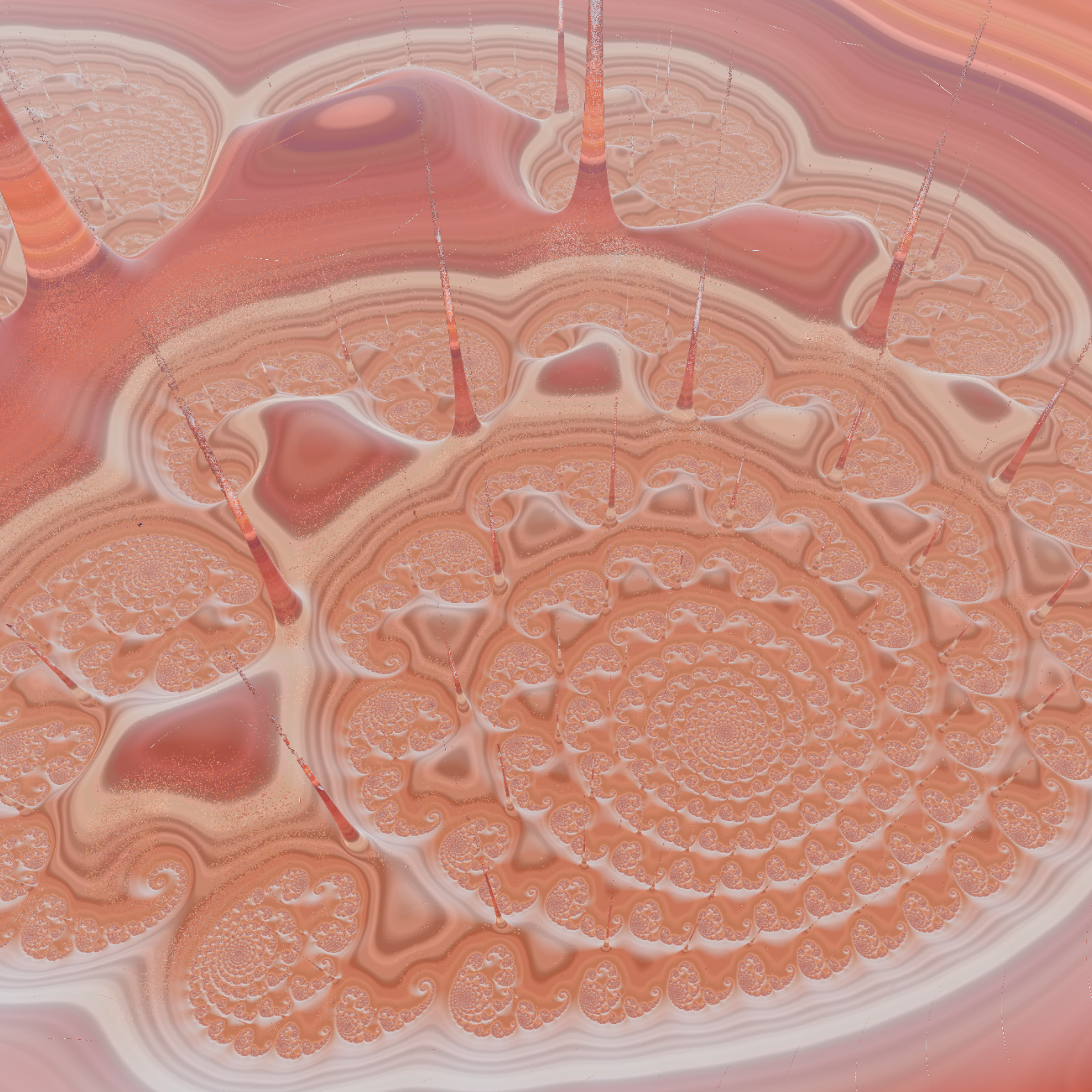
Juliascape
Fractals are some of the most beautiful and ubiquitous ways to generate global structure from purely local rules, but they almost always appear as 2D rasters. Here, I've written an OpenGL 3D fractal renderer, allowing you to experience them as a landscape. I do two cool mathematical tricks to make this possible: first, instead of doing a pixel-by-pixel iteration to compute the fractal, I can use something called the Douady-Hubbard potential, and second, instead of raytracing such a surface, I use an alternate technique called raymarching!
These fractals are called Julia sets. Each one is uniquely associated with a single complex number, meaning that there are an infinite number of them. This renderer lets you specify any "seed" number, allowing you to sample any one you wish.
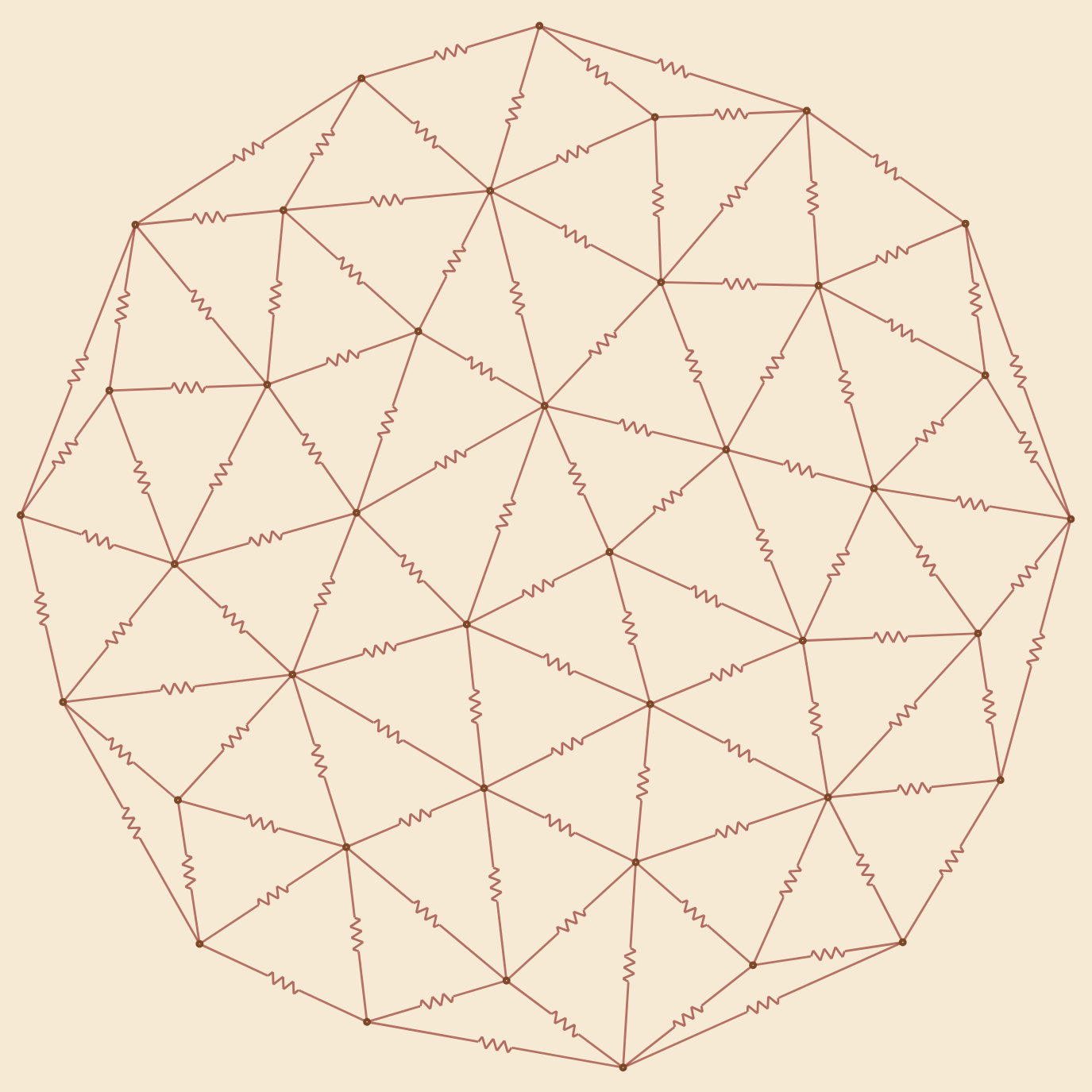
Planar Circuit Visualizer
I wrote this simulator for myself when I was trying to understand the projector formalism for resistive meshes with on-edge voltage sources, but it's really fun to just set voltages on various edges and watch flows emerge throughout the entire network!
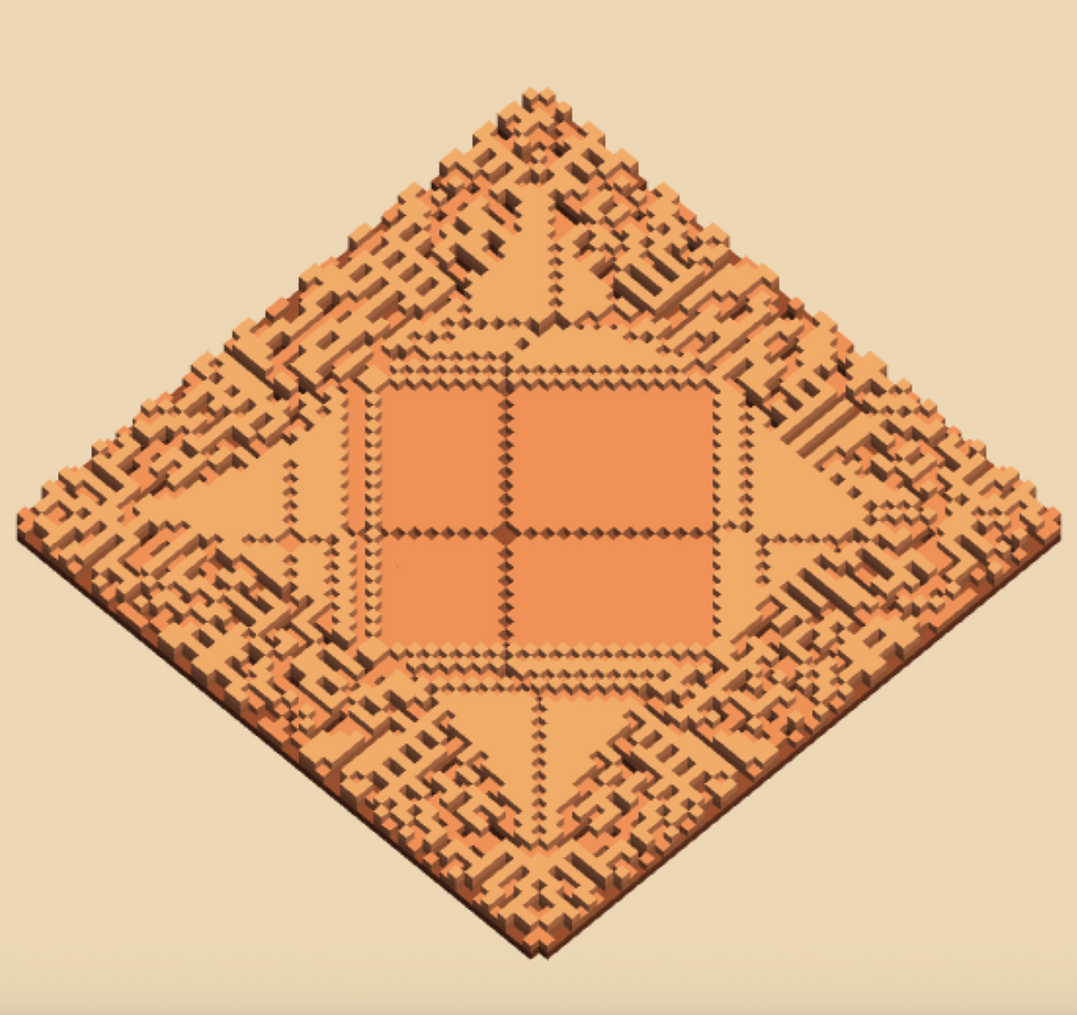
Abelian Sandpile
This is a demo I made for the Santa Fe Institute, designed as a literal sandbox demo of one of the most foundational thought experiments in complex systems theory. Originally it was introduced by Per Bak and co. in the late 80s, like so many cool ideas that are still relevant today. I wrote the renderer from scratch - each "cube" is actually just a distorted square, but this means I can render a huge number of cubes rather fast. You can click to place your own grains of sand and influence the simulation!
The sandpile is called abelian because of the way the update rules work - piles of sand "topple" when they're four grains or higher, and you'll reach the same final state regardless of what order you topple piles in. This means that the toppling operation is abelian (it commutes with other topple-ops). Incidentally, this property lets me save quite a bit of pain in coding the update rules for the simulation...
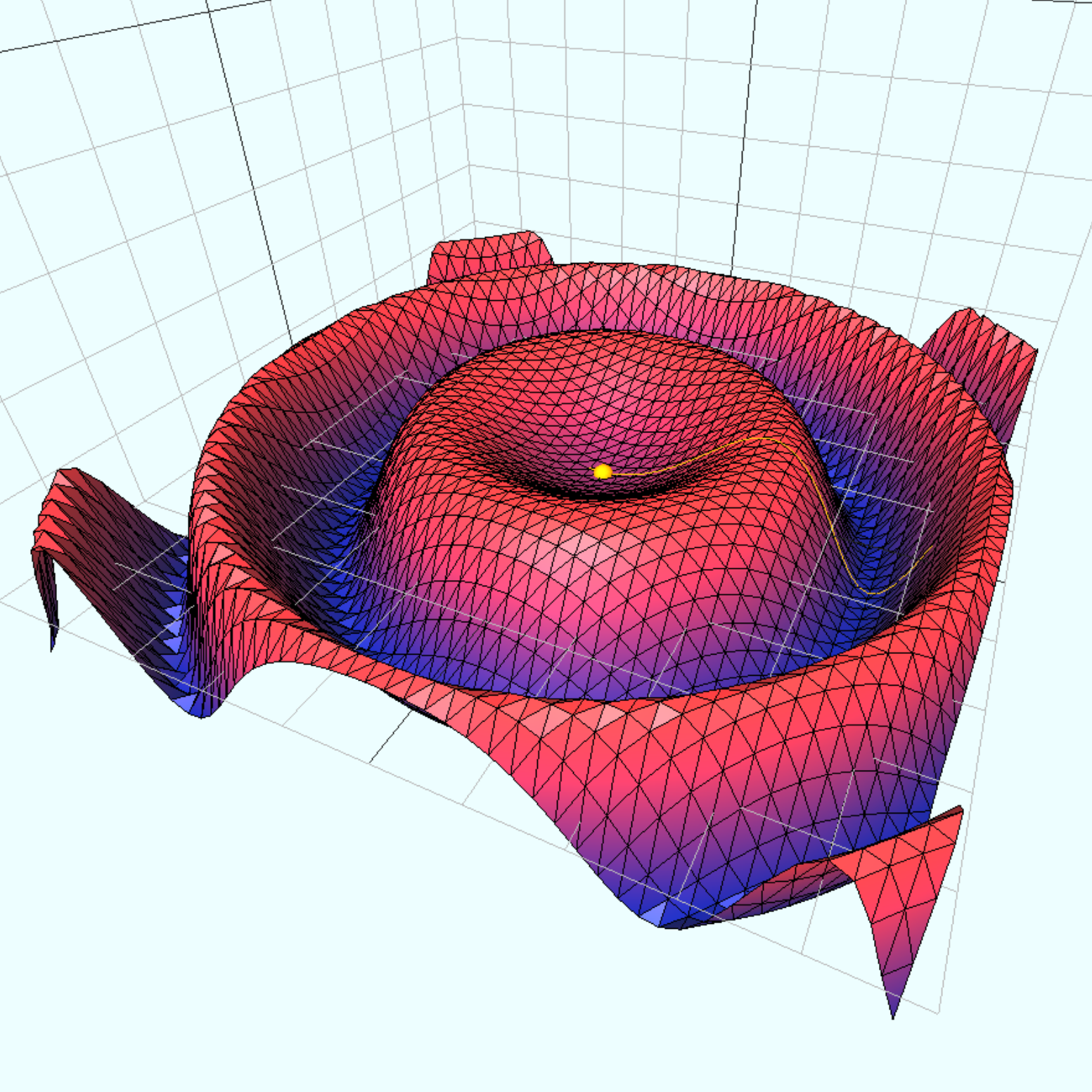
Gradbowl
We often read about optimizer hyperpameters like "momentum", "alpha", and "beta", but what do these actually mean in practice?
Here, you can specify a landscape of your own making and set different optimizers to work. Play with hyperparameters and see how these change the trajectories of the balls as they struggle downhill. See if you can find the right parameters to make optimizers escape local minima.
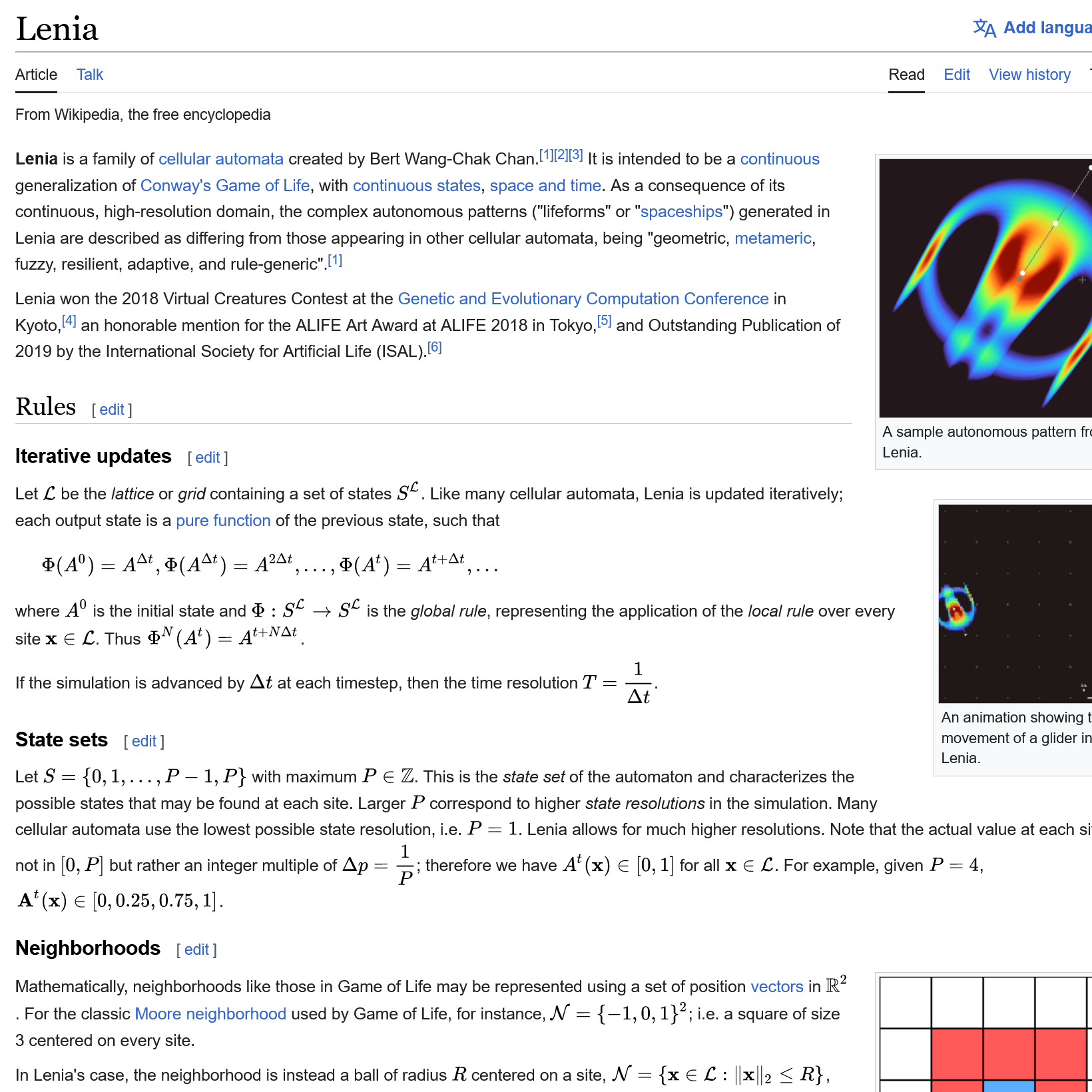
Lenia
Well, not Lenia itself - instead, this is a Wikipedia article I wrote about this clever continuous-space extension of discrete cellular automata like Conway's Game of Life.